The Next Phase of Digital Transformation
Many organizations today experiment with artificial intelligence tools, yet very few have AI systems that truly understand how their business operates.
While AI already supports tasks such as content creation, analytics, and customer service, the next stage of digital transformation goes beyond adopting tools. It focuses on building AI systems that understand business processes, internal terminology, operational rules, and real decision-making contexts.
At Manao Software, the focus goes beyond implementing standalone AI models. Instead, the team designs AI systems that integrate directly into operational workflows, internal knowledge bases, and business processes.
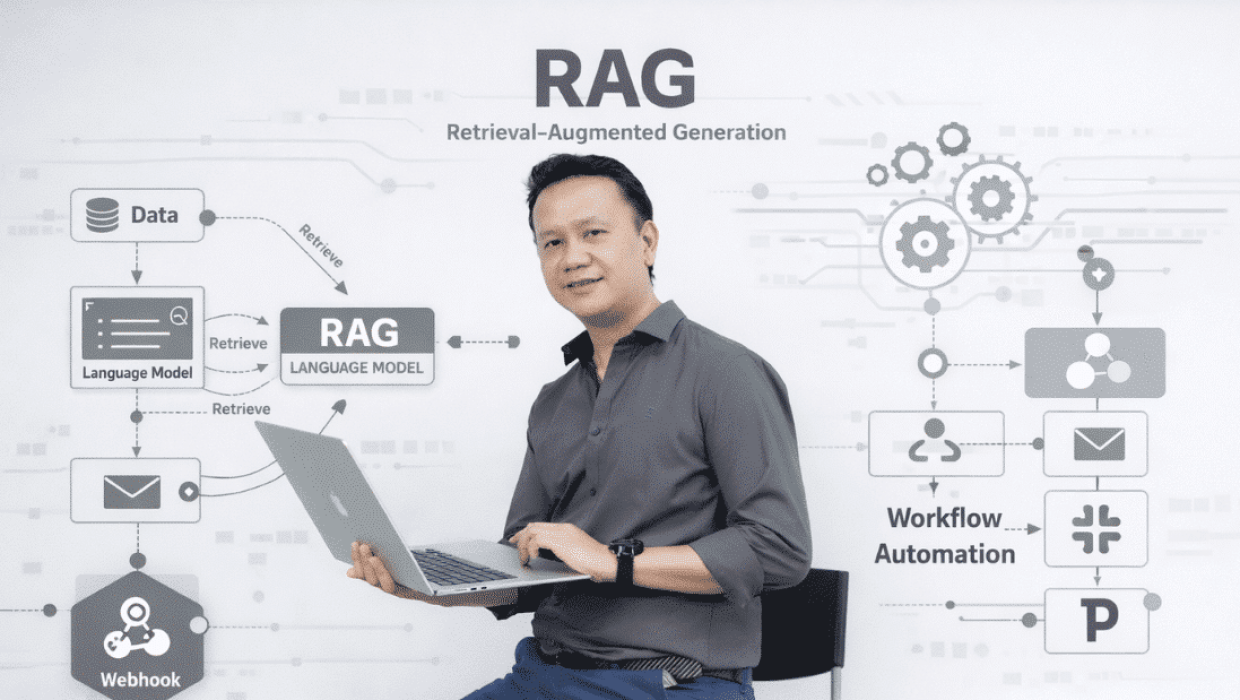
When AI is embedded into operational systems rather than used as an isolated tool, it becomes part of the organization’s digital infrastructure, supporting decision-making, improving efficiency, and enabling scalable growth. Technologies such as Retrieval-Augmented Generation (RAG) and workflow automation are helping organizations move toward this new stage of intelligent operations. This evolution represents a new standard for AI-augmented software development, where intelligent systems become embedded infrastructure rather than standalone tools.
Why Businesses Need AI That Understands Their Operations
General AI models are designed to perform a wide range of tasks. While this flexibility is valuable, businesses often need systems that understand their specific operational context.
From Manao Software’s perspective, “AI that understands a business” refers to AI systems that are deeply connected to a company’s internal knowledge and operational processes.
This includes understanding:
– Internal terminology and documentation
– Operational workflows and procedures
– Industry-specific requirements
– Business rules and operational exceptions
Building this type of system requires more than simply deploying a large language model. It requires purposeful AI software development that connects domain knowledge, operational data, and business workflows into a coherent and maintainable system. It involves combining domain-specific datasets, contextual training, and integration with internal platforms where important operational knowledge is stored.
When AI has access to this context, it can generate insights that align with real business operations rather than producing generic responses. According to McKinsey & Company, organizations that align AI initiatives with operational processes and business strategy are significantly more likely to achieve measurable impact from their AI investments.
How RAG Helps AI Use Internal Business Knowledge

One of the key technologies enabling business-aware AI is Retrieval-Augmented Generation (RAG).
Traditional AI systems rely mainly on information learned during training. While this knowledge can be useful, organizations often maintain large internal knowledge bases that evolve constantly.
Without access to these internal data sources, AI systems may generate responses that are incomplete, outdated, or disconnected from real company knowledge.
RAG addresses this limitation by combining two key components:
– A retrieval system that searches internal knowledge sources.
– A generative AI model that produces responses using the retrieved information.
When a user asks a question or triggers a task, the system first retrieves relevant information from internal documents, databases, or knowledge bases before generating a response.
This approach allows AI systems to ground their outputs in trusted organizational data, rather than relying only on training data. Industry research shows that RAG improves the reliability of AI systems by grounding responses in retrieved evidence from trusted data sources rather than relying only on model training data.
Example: RAG Supporting Sales Decision-Making
One practical example of this approach is the RAG AI Knowledge Engine for Sales Decision Support, where AI retrieves relevant project information to help sales teams respond to client inquiries quickly and accurately.
Sales teams often receive questions such as:
– “Have you built something like this before?”
– “How long would a similar project take?”
– “What would a comparable project cost?”
Although this information already exists in proposal documents and project archives, it is often scattered.
RAG solves this by organizing internal documents, converting them into searchable data, retrieving relevant project examples, and generating responses based on company knowledge. This allows sales teams to access project insights instantly and respond more confidently and efficiently.
Research, including studies published in Harvard Business Review, shows that generative AI can improve productivity and decision-making in knowledge-intensive work by helping employees quickly access relevant information. Systems like this also transform scattered internal knowledge into a reusable business asset.
The Importance of Data Architecture for AI Systems
Successful AI implementation depends heavily on the quality and structure of organizational data.
Many companies store valuable information across multiple systems, departments, and formats. When data is fragmented, AI systems struggle to retrieve reliable insights even when advanced models are used.
Building a strong data foundation is therefore a critical step in any digital transformation initiative.
Typical improvements include:
– Integrating data across multiple systems.
– Creating a unified data layer or central repository.
– Standardizing data formats and structures.
– Improving data accessibility for operational teams.
Once this foundation is in place, technologies like RAG can retrieve information efficiently and support more accurate AI outputs.
Turning AI into Real Value with Workflow Automation

While AI can generate insights, real business value appears when those insights are embedded directly into operational workflows.
This is where workflow automation becomes essential. For organizations ready to move beyond isolated experiments, working with an AI delivery platform that combines RAG retrieval, workflow orchestration, and operational integration makes this transition faster and more reliable. Workflow automation connects AI capabilities with real business processes, allowing tasks to move automatically through defined operational steps.
At Manao Software, this approach is applied internally in the company’s inbound lead workflow.
When a potential client sends an inquiry via email, the system automatically:
– Evaluates the quality and relevance of the lead.
– Extracts key information from the message.
– Summarizes the client’s request.
– Records the data in the CRM system.
– Creates follow-up tasks for the sales team.
Instead of manually reviewing each email, the sales team receives structured insights and prioritized opportunities. This allows the team to focus on meaningful engagement with potential clients rather than administrative work.
More importantly, AI-enabled workflows allow organizations to scale operations without increasing headcount proportionally, improving both efficiency and cost management. According to Deloitte, organizations combining AI with process automation often achieve significant productivity gains by reducing manual workloads and accelerating decision cycles.
Common Mistakes When Implementing AI and Automation
As organizations explore RAG and workflow automation, success often depends on avoiding several common pitfalls.
Starting Without a Clear Objective
One of the most common mistakes is adopting AI technologies before clearly defining the business problem they are meant to solve. Organizations that begin with clear operational goals typically achieve stronger results.
Limited Data Readiness
AI systems rely on structured and accessible data. When data remains fragmented across departments or systems, technologies such as RAG cannot retrieve information effectively.
Overcomplicating Solutions Too Early
Introducing multiple AI tools or complex automation layers too early can slow down implementation. Starting with focused use cases and expanding gradually often leads to better long-term outcomes.
Lack of Workflow Integration
AI delivers the greatest value when insights are integrated directly into operational processes rather than used as standalone tools.
Designing Scalable AI Systems
As AI becomes more integrated into business operations, organizations benefit from building systems that can evolve over time.
One important design principle is modular architecture. Scalable outcomes depend on treating AI-assisted development as an ongoing practice, not a one-time project, iterating on models, data pipelines, and workflow integrations as business needs evolve. Technology leaders increasingly emphasize modular and API-driven architectures when implementing enterprise AI. According to insights from IBM, well-designed AI architectures allow organizations to scale systems, integrate new technologies, and evolve platforms without rebuilding entire infrastructures.
Rather than building rigid systems, modular architectures allow organizations to update individual components, such as AI models, data connectors, or workflow engines without rebuilding the entire platform.
Key principles that support scalable AI systems include:
– Modular system design
– Open APIs for integration
– Adaptable data pipelines
– Strong documentation and knowledge sharing
This approach allows organizations to expand and refine their AI capabilities as business needs evolve.
AI Governance, Security, and Data Permissions

As AI systems become more connected to internal platforms, governance and security become increasingly important.
This is particularly relevant when implementing RAG, since the system retrieves information from internal knowledge sources. To maintain proper data access controls, permission management can be integrated directly into the retrieval process.
For example, role-based filters ensure that the AI system only returns information that a user is authorized to access.
Additional governance practices may include:
– Monitoring AI outputs for accuracy
– Validating data sources regularly
– Maintaining clear data management policies
– Allowing human review for critical decisions
These measures help ensure that AI-driven processes remain reliable while protecting sensitive company data.
Industries Benefiting from RAG and Workflow Automation
Across Thailand and the broader Asian market, several industries are well positioned to benefit from these technologies. Industries with complex workflows and large volumes of operational data often see the greatest impact.
Examples include:
Finance
AI systems can retrieve financial knowledge in real time, support customer service processes, and improve operational efficiency.
Healthcare
AI-assisted workflows help organize medical data, streamline administrative tasks, and support clinical decision-making.
Manufacturing
Automation and AI insights support supply chain coordination, production planning, and operational monitoring.
Signs Your Organization Is Ready for AI-Driven Operations
While AI technologies are becoming increasingly accessible, successful adoption usually begins with the right organizational foundation.
Common indicators include:
– A strong culture of data-driven decision-making.
– Well-documented business processes.
– Clearly identified operational inefficiencies.
– Leadership support for innovation and technology adoption.
Organizations with these foundations can introduce AI gradually and expand capabilities as operational needs evolve.
Conclusion: From AI Experiments to Intelligent Business Operations
Artificial intelligence is evolving from a supporting technology into a core component of modern business infrastructure. Organizations that combine RAG, workflow automation, and strong data foundations can build AI systems that understand internal knowledge and support real operational workflows.
At Manao Software, the focus is on integrating AI directly into business processes, from retrieving relevant knowledge through RAG to embedding AI insights into automated workflows.
This approach helps organizations streamline operations, accelerate decision-making, and scale efficiently as they grow. As AI continues to evolve, businesses that build context-aware, workflow-integrated AI systems will be better positioned to compete in increasingly data-driven markets.
If you’re exploring how RAG and workflow automation can support smarter operations, our team is here to help. To learn more about how RAG supports intelligent business operations, explore: https://manaosoftware.com/portfolio/rag-ai/